
Table of Contents
Introduction
Have you ever added fish to a new aquarium, only to worry about whether the water is truly safe?
A clear tank does not always mean your aquarium is ready for fish. Many beginners in the USA make this mistake because they cannot see the beneficial bacteria working inside the filter. Completing the nitrogen cycle is one of the most important steps before adding aquatic life.
Learning how to know when an aquarium is cycled helps protect fish from dangerous ammonia and nitrite spikes. A properly cycled tank creates a safer environment and reduces stress for both new and experienced fish keepers.
In this guide, you will discover the real signs of a cycled aquarium, how to test your water, and when your tank is ready for fish. You will also learn how to avoid common cycling mistakes that can harm your aquarium.
How Do You Know When an Aquarium Is Fully Cycled?
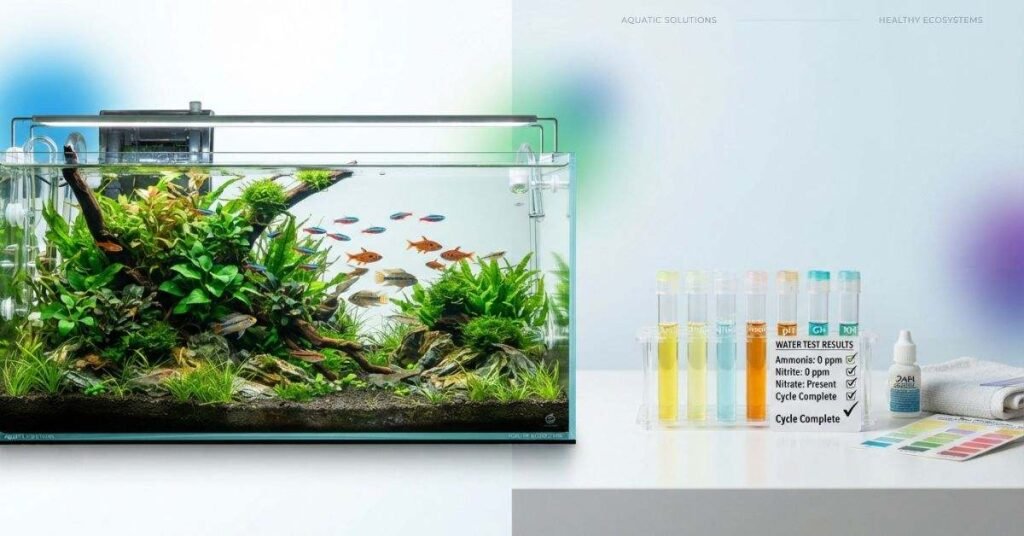
You know an aquarium is fully cycled when it can safely handle waste without dangerous ammonia or nitrite spikes. The main signs include ammonia and nitrite levels staying at 0 ppm, while nitrate is present in the water.
A cycled aquarium has enough beneficial bacteria in the filter and substrate to break down harmful waste. These bacteria convert ammonia into nitrite and then nitrite into nitrate through the nitrogen cycle.
Before adding fish, test your water regularly to confirm stable results. A reliable way to check the cycle is an ammonia challenge. The tank should process an ammonia source within about 24 hours while keeping ammonia and nitrite at 0 ppm.
A clear aquarium does not always mean the cycle is complete. Water tests provide the best proof that your tank is ready for fish.
Key Takeaways:
- Ammonia should read 0 ppm.
- Nitrite should read 0 ppm.
- Nitrate should be detectable.
- Water parameters should remain stable over time.
What Does a Fully Cycled Aquarium Mean?
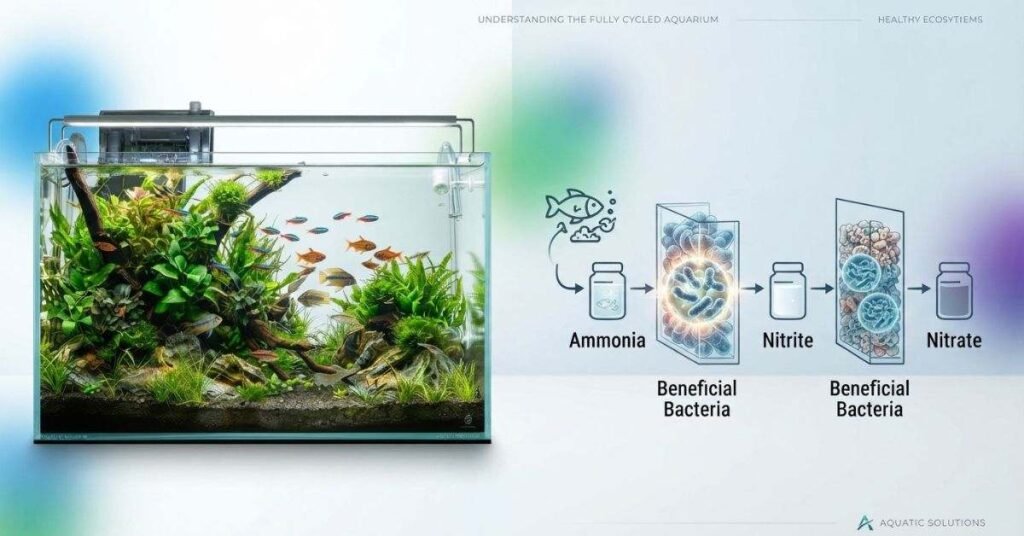
A fully cycled aquarium has an established biological system that safely handles fish waste. The tank contains enough beneficial bacteria to convert toxic ammonia into nitrite and then into less harmful nitrate.
The cycling process creates a stable environment where fish can live safely. Without this process, ammonia and nitrite can build up quickly and stress or harm fish. Many beginners think a new aquarium is ready when the water looks clear, but clear water does not confirm a completed cycle.
A cycled aquarium depends on water test results, not appearance. When ammonia and nitrite stay at 0 ppm and nitrate is present, your tank shows signs of a working nitrogen cycle.
Internal Link Suggestion: Add a link to your guide about the [Aquarium Nitrogen Cycle] when explaining how bacteria process waste.
Beneficial Bacteria Are Established
Beneficial bacteria are the foundation of a fully cycled aquarium. These microscopic organisms grow mainly inside your filter media, substrate, and other surfaces in the tank.
The first group of bacteria converts ammonia from fish waste, leftover food, and decaying matter into nitrite. A second group then converts nitrite into nitrate, which is easier to manage through water changes and plant growth.
A new aquarium needs time for these bacteria to multiply. Adding fish too soon can create more waste than the bacteria can handle. This causes ammonia or nitrite levels to rise.
A healthy bacterial colony helps your aquarium maintain stable water quality. Keeping the filter running continuously protects these important bacteria and supports long-term tank health.
Pro Tip: Avoid replacing all filter media at once because it can remove a large amount of beneficial bacteria.
The Nitrogen Cycle Is Complete
The nitrogen cycle is complete when your aquarium can naturally process waste through each stage without dangerous spikes. This means ammonia changes into nitrite, and nitrite changes into nitrate successfully.
During cycling, ammonia and nitrite may appear as bacteria develop. Over time, these levels should drop to 0 ppm while nitrate becomes detectable.
A completed cycle does not mean your aquarium stops producing waste. Fish will continue adding waste every day. Instead, it means your beneficial bacteria can keep up with normal waste production.
Testing your water helps confirm that the cycle works correctly. Regular monitoring also helps you catch problems before they affect your fish.
A stable nitrogen cycle is one of the most important parts of successful aquarium care.
7 Signs Your Aquarium Is Fully Cycled
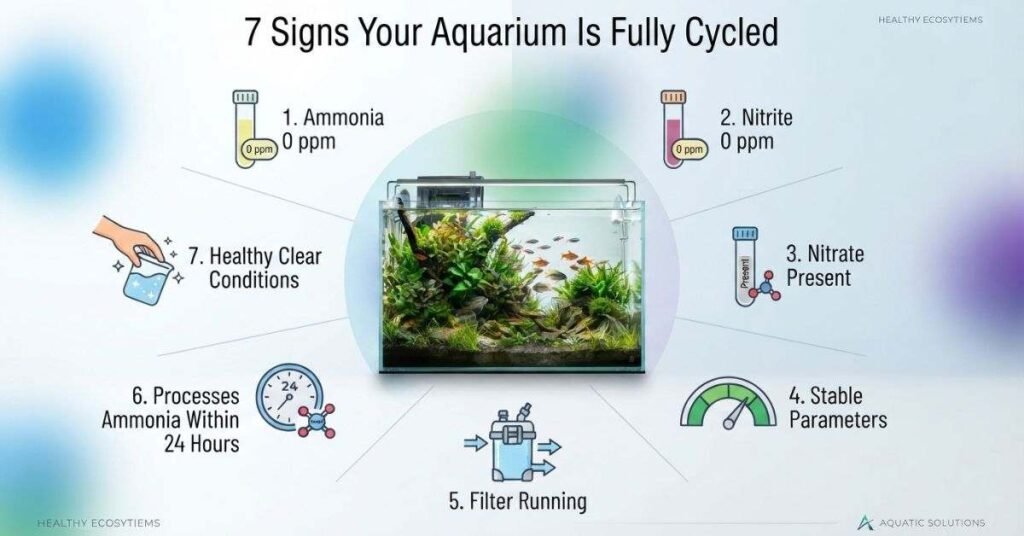
Knowing the signs of a cycled aquarium helps you avoid adding fish too early. A tank may look clean, but only testing can confirm whether the biological system works properly.
Look for these important signs before introducing fish:
- Ammonia remains at 0 ppm.
- Nitrite remains at 0 ppm.
- Nitrate is detectable.
- Water parameters stay stable.
- The filter works correctly.
- The tank processes ammonia within 24 hours.
- No unusual odors or cloudy water appear.
Each sign gives you more confidence that your aquarium can support fish safely.
Sign 1 – Ammonia Reads 0 ppm
Ammonia at 0 ppm is one of the strongest signs your aquarium is cycled. Fish waste and decomposing materials naturally create ammonia, which is highly toxic to fish.
In a healthy cycled aquarium, beneficial bacteria quickly break down ammonia before it reaches harmful levels. A test reading above 0 ppm means your tank may still be cycling or cannot handle its current waste load.
Test ammonia regularly during the cycling process. Wait until readings stay at 0 ppm consistently before adding fish.
Sign 2 – Nitrite Reads 0 ppm
Nitrite is another harmful compound that appears during the aquarium cycle. It forms when bacteria break down ammonia but can still damage fish if levels become too high.
A fully cycled aquarium converts nitrite into nitrate efficiently. This means your test results should show 0 ppm nitrite before adding fish.
If nitrite appears during testing, your bacterial colony may still be developing. Continue cycling and avoid adding new fish until the level returns to zero.
Sign 3 – Nitrate Is Detectable
Detectable nitrate usually shows that the nitrogen cycle is working. It means beneficial bacteria have successfully converted nitrite into nitrate.
Unlike ammonia and nitrite, nitrate is less toxic at normal aquarium levels. However, it can build up over time and requires regular water changes.
A cycled aquarium often has some nitrate present. A reading of zero nitrate does not always mean the tank is not cycled, especially in heavily planted aquariums.
Sign 4 – Water Parameters Are Stable
Stable water parameters show that your aquarium can maintain a healthy environment. A cycled tank should keep ammonia and nitrite at zero while maintaining consistent pH and nitrate levels.
Avoid checking your water only once. Test results should remain stable over several checks before adding fish.
Sudden changes may indicate that the bacterial colony needs more time to develop.
Sign 5 – The Filter Is Running Properly
Your aquarium filter plays a major role in maintaining the nitrogen cycle. Beneficial bacteria need oxygen-rich water movement to survive and process waste.
A properly working filter should provide steady flow without unusual problems. Turning off the filter for long periods can reduce oxygen levels and affect bacteria.
Keep your filter running continuously to protect your biological filtration.
Sign 6 – The Tank Processes Ammonia Within 24 Hours
An ammonia challenge can help confirm that your aquarium is ready for fish. This test checks whether your tank can process an ammonia source quickly.
A fully cycled aquarium should convert added ammonia into nitrite and then nitrate within about 24 hours, with ammonia and nitrite returning to 0 ppm.
This step gives extra confidence before adding fish.
Sign 7 – No Unusual Odors or Cloudiness
A healthy cycled aquarium should not have strong rotten smells or persistent cloudy water. Strange odors may indicate excess waste or an imbalance.
Cloudiness can happen during cycling because bacteria multiply quickly. However, ongoing cloudy water may signal that your tank still needs time to stabilize.
Clear water alone does not prove cycling is complete, but stable, clean conditions support a healthy aquarium.
How to Test if Your Aquarium Is Fully Cycled
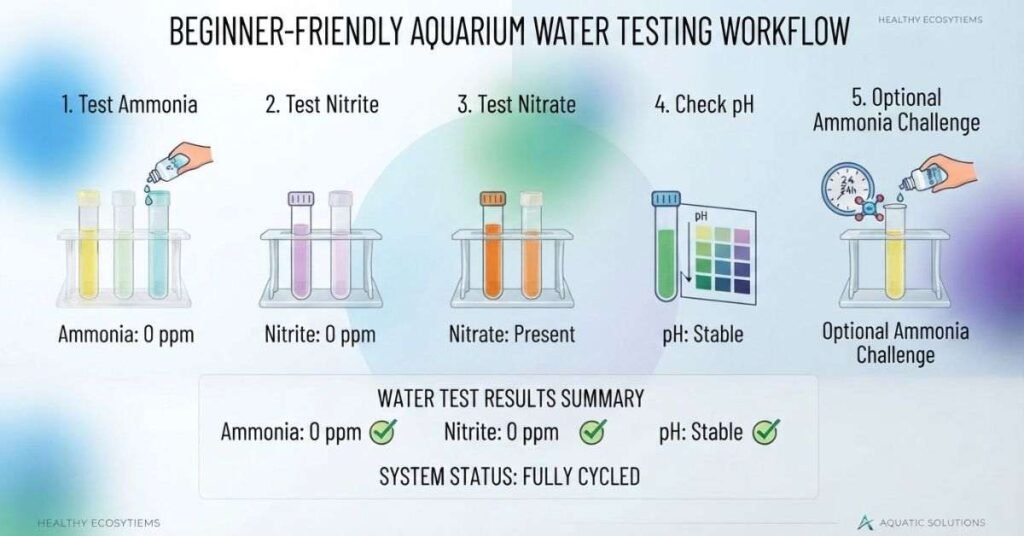
Testing your water is the most reliable way to know if your aquarium is cycled. A tank may look clean, but harmful ammonia or nitrite can still be present.
Use a reliable aquarium test kit to check key water parameters before adding fish. These tests show whether beneficial bacteria are processing waste correctly.
Follow these steps to confirm your aquarium cycle:
| Parameter | Ideal Reading |
|---|---|
| Ammonia | 0 ppm |
| Nitrite | 0 ppm |
| Nitrate | Present |
| pH | Stable |
Step 1 – Test Ammonia
Start by checking your ammonia level. Ammonia comes from fish waste, leftover food, and decaying materials inside the aquarium.
A fully cycled aquarium should process ammonia quickly, keeping the reading at 0 ppm. Any measurable ammonia means your tank may not be ready for fish yet.
Test ammonia during the cycling process and confirm that the level stays at zero consistently.
Step 2 – Test Nitrite
Next, test for nitrite. Nitrite appears when beneficial bacteria break down ammonia, but it remains dangerous for fish.
A cycled aquarium should convert nitrite into nitrate efficiently. Your test should show 0 ppm nitrite before adding fish.
If nitrite is still detectable, continue cycling and allow more bacteria to develop.
Step 3 – Test Nitrate
Nitrate is the final product of the nitrogen cycle. Detectable nitrate usually indicates that bacteria are successfully converting waste.
Unlike ammonia and nitrite, nitrate is less harmful at normal levels. However, high nitrate levels can affect fish health over time.
Check your nitrate reading and perform a water change if the level becomes too high before adding fish.
Step 4 – Check pH
Stable pH is another important part of a healthy aquarium. Beneficial bacteria work best when water conditions remain consistent.
Your ideal pH depends on the fish species you plan to keep. Focus on stability rather than chasing a specific number.
Sudden pH changes can stress fish and affect the nitrogen cycle.
Step 5 – Perform an Ammonia Challenge
An ammonia challenge provides extra confirmation that your tank can handle fish waste. This test adds a controlled ammonia source and checks how quickly the bacteria process it.
A fully cycled aquarium should convert the ammonia source within about 24 hours while keeping ammonia and nitrite at 0 ppm.
This step is especially helpful before adding fish to a brand-new aquarium.
Pro Tip: Test your water several times before adding fish instead of relying on one test result.
Can You Add Fish Immediately After Cycling?
You can add fish after your aquarium completes the cycle, but avoid adding too many fish at once. A newly cycled tank has beneficial bacteria, but the colony may need time to adjust to a larger waste load.
Before adding fish, check your final water readings. If nitrate levels are high, perform a partial water change to improve water quality.
Start with a small number of fish and add more gradually. This gives beneficial bacteria time to grow with the increasing waste produced by new fish.
Avoid fully stocking the aquarium on day one. Adding many fish at once can overwhelm the biological filter and cause ammonia or nitrite spikes.
A slow stocking approach helps maintain a stable environment and protects your fish.
Common Signs Your Aquarium Is NOT Fully Cycled
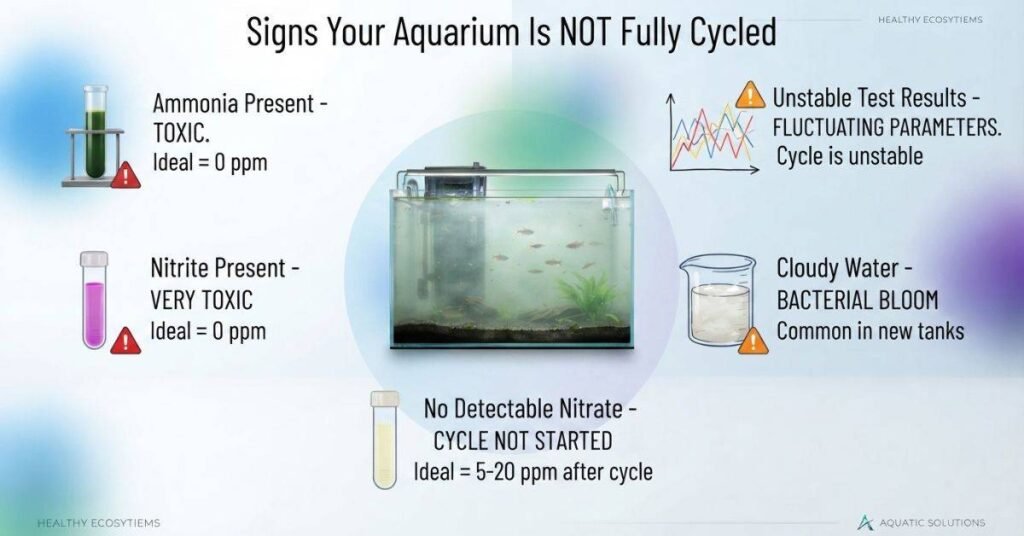
Knowing when an aquarium is not fully cycled can prevent serious problems after adding fish. Several warning signs can show that beneficial bacteria have not fully established.
Ammonia Is Still Present
Any detectable ammonia can indicate that your biological filter cannot process the current waste load. Keep cycling and avoid adding fish until ammonia returns to 0 ppm consistently.
Nitrite Is Still Present
Nitrite should also reach 0 ppm before adding fish. If nitrite remains detectable, give the bacterial colony more time to develop.
No Detectable Nitrate
No nitrate can mean the cycle has not progressed enough. However, heavily planted aquariums can sometimes show very low nitrate because plants consume it.
Cloudy Bacterial Bloom
Cloudy water often appears during aquarium cycling as bacterial populations change. It does not automatically mean the cycle has failed. Continue testing ammonia and nitrite while keeping the filter running.
Unstable Test Results
If ammonia or nitrite repeatedly rises and falls, your aquarium may still be developing its biological capacity. Continue cycling and test every few days.
If these signs appear, don’t rush the process. Keep the filter running, maintain your ammonia source, and monitor water parameters until results stabilize.
Pro Tip: Don’t add fish simply because ammonia reaches zero once. Confirm that ammonia and nitrite remain at 0 ppm consistently.
Visual Suggestion:
Image Idea: Comparison infographic showing five warning signs of an incomplete aquarium cycle.
Caption: “These warning signs can show that your aquarium still needs time to cycle.”
SEO Alt Text: “signs aquarium is not fully cycled including ammonia nitrite and cloudy water”
Common Mistakes When Checking the Cycle
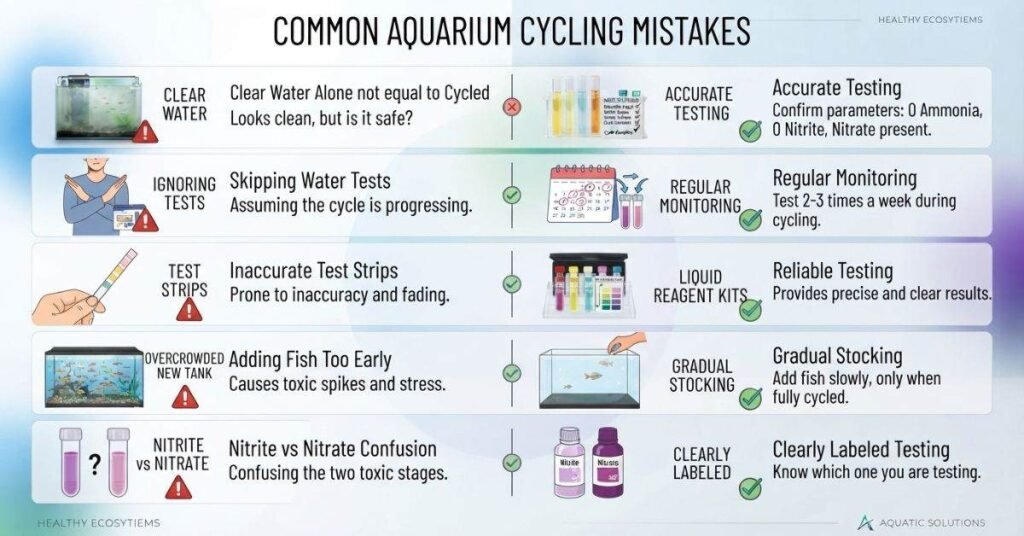
Many beginners focus on appearance instead of water chemistry when deciding whether their aquarium is ready. Avoiding these mistakes makes it easier to confirm a completed cycle.
Judging by Clear Water Alone
Clear water does not prove that beneficial bacteria are established. An aquarium can look perfectly clean while ammonia or nitrite remains dangerous.
Always use water tests alongside visual observations.
Skipping Water Testing
Without testing, you cannot reliably confirm that the nitrogen cycle is complete. Check ammonia, nitrite, nitrate, and pH before adding fish.
Using Inaccurate Test Strips
Test strips can provide useful quick checks, but some kits may offer less precise readings than liquid tests. Follow the manufacturer’s instructions carefully and replace expired testing supplies.
Adding Fish Too Early
Adding fish before the cycle finishes can create dangerous ammonia and nitrite spikes. Wait for consistent test results before introducing livestock.
Confusing Nitrate With Nitrite
Nitrate and nitrite have different roles in the nitrogen cycle. Nitrite remains toxic to fish, while nitrate is the less harmful end product of biological filtration.
Always check the exact parameter shown on your test kit before making decisions.
Common Mistakes When Checking the Cycle
Many beginners focus on appearance instead of water chemistry when deciding whether their aquarium is ready. Avoiding these mistakes makes it easier to confirm a completed cycle.
Judging by Clear Water Alone
Clear water does not prove that beneficial bacteria are established. An aquarium can look perfectly clean while ammonia or nitrite remains dangerous.
Always use water tests alongside visual observations.
Skipping Water Testing
Without testing, you cannot reliably confirm that the nitrogen cycle is complete. Check ammonia, nitrite, nitrate, and pH before adding fish.
Using Inaccurate Test Strips
Test strips can provide useful quick checks, but some kits may offer less precise readings than liquid tests. Follow the manufacturer’s instructions carefully and replace expired testing supplies.
Adding Fish Too Early
Adding fish before the cycle finishes can create dangerous ammonia and nitrite spikes. Wait for consistent test results before introducing livestock.
Confusing Nitrate With Nitrite
Nitrate and nitrite have different roles in the nitrogen cycle. Nitrite remains toxic to fish, while nitrate is the less harmful end product of biological filtration.
Always check the exact parameter shown on your test kit before making decisions.
What to Do If Your Aquarium Isn’t Fully Cycled
If your aquarium still shows ammonia or nitrite, don’t rush to add fish. An incomplete cycle simply means the biological filter needs more time to develop.
Continue cycling and keep your filter running continuously. Beneficial bacteria need a steady supply of oxygenated water and an ammonia source to establish a strong colony.
Test ammonia, nitrite, and nitrate every few days. Record your results so you can spot a clear trend toward stable readings.
Avoid adding more fish while ammonia or nitrite remains detectable. Additional livestock creates more waste and can overwhelm the developing bacterial population.
You should also monitor your ammonia source during fishless cycling. The bacteria need an appropriate waste source, but excessive ammonia can interfere with the cycling process.
Once ammonia and nitrite consistently reach 0 ppm, confirm your results with additional tests. Then perform a water change if nitrate has accumulated to an unsuitable level.
Pro Tip: Don’t restart the entire cycle because one test looks unusual. Check your equipment, retest the water, and look for a consistent pattern first.
Freshwater vs Saltwater: Are the Signs Different?
The basic signs of a cycled aquarium are similar in freshwater and saltwater systems. Both rely on beneficial bacteria to process ammonia and nitrite through the nitrogen cycle.
The main differences involve livestock, equipment, water chemistry, and maintenance routines. Saltwater aquariums often require additional testing because marine animals can have specific water-quality needs.
However, the core cycling indicators remain familiar. Ammonia should reach 0 ppm, and nitrite should also reach 0 ppm. Nitrate can indicate that the biological filtration is processing nitrogen waste.
| Freshwater | Saltwater |
|---|---|
| Uses the same basic nitrogen cycle | Uses the same basic nitrogen cycle |
| Supports freshwater livestock | Supports marine livestock |
| Uses freshwater-specific equipment | Uses marine-specific equipment |
| Requires similar ammonia and nitrite testing | Requires similar ammonia and nitrite testing |
| Nitrate management remains important | Nitrate management remains important |
Whether you keep freshwater fish or marine livestock, don’t rely on clear water alone. Test your parameters and confirm that the biological filter can process waste before adding livestock.
Pro Tip: Choose tests designed for your specific aquarium type. Marine systems may require additional parameters beyond the basic cycling tests.
Conclusion
Knowing how to know when an aquarium is cycled starts with testing, not simply looking at clear water. Ammonia and nitrite should consistently read 0 ppm, while nitrate is typically detectable. Stable water parameters and a functioning filter provide additional confidence.
Taking a few extra days to confirm the cycle can help protect new fish from unnecessary stress. Don’t rush the process because your aquarium looks clean or clear. A little patience gives your biological filter time to establish properly.
After adding your first fish, continue monitoring ammonia and nitrite closely. Add livestock gradually and respond quickly if water parameters change.
Ready to check your tank? Test your water today and use these signs to decide if it’s truly ready. Share your cycling experience or questions in the comments.
Frequently Asked Questions
You know your aquarium is fully cycled when ammonia and nitrite consistently test at 0 ppm. Nitrate should usually be detectable, unless plants consume it quickly. For extra confirmation, perform an ammonia challenge. A mature biological filter should process the ammonia source within about 24 hours while ammonia and nitrite return to 0 ppm.
Yes, an aquarium can look completely clear before the nitrogen cycle finishes. Clear water only shows that the water looks clean. It does not prove that beneficial bacteria can process ammonia and nitrite. Always test your water before adding fish. Ammonia and nitrite readings provide much better evidence than water appearance.
Yes. A properly cycled aquarium should normally show 0 ppm ammonia under its established waste load. Fish continuously produce waste, so ammonia enters the water regularly. Beneficial bacteria should process it before it accumulates. If you detect ammonia, investigate the cause and retest before adding more fish.
There is no single nitrate level that proves an aquarium is fully cycled. Detectable nitrate can show that bacteria are converting nitrite into nitrate. However, nitrate levels vary between tanks, especially in planted aquariums. Focus on consistent 0 ppm ammonia and nitrite readings rather than using nitrate alone to confirm the cycle.
It’s better to add fish gradually instead of fully stocking the aquarium on day one. A newly cycled tank may need time to adjust to a larger waste load. Adding too many fish at once can increase ammonia and nitrite faster than the biological filter can process them. Introduce livestock in manageable groups and monitor water quality afterward.
No. Live plants can absorb ammonia compounds and nitrate, but they do not automatically prove that your biological filter is fully established. Heavily planted tanks may also show very low nitrate readings. Use ammonia and nitrite testing to confirm the cycle instead of relying on plants or water appearance.
You don’t necessarily need to wait a fixed number of days after confirming the cycle. Once ammonia and nitrite consistently reach 0 ppm, your tank can process an appropriate ammonia source, and water conditions are stable, you can begin stocking gradually. Check nitrate and perform a water change if needed before adding fish.
Yes. Beneficial bacteria can decline if their environment changes significantly. Problems can occur when the filter remains off for too long, biological media gets heavily cleaned, or the aquarium loses its regular ammonia source. Avoid replacing all biological filter media at once. Keep filtration running and monitor ammonia and nitrite after major changes.
Don’t add fish while nitrite remains detectable. Continue cycling and keep the filter running. Test ammonia and nitrite every few days to monitor progress. If fish are already present, take appropriate steps to protect them and closely monitor water quality. Don’t assume the aquarium is cycled until nitrite consistently returns to 0 ppm.
A water change can be helpful before adding fish, especially when nitrate has accumulated during cycling. The amount and timing depend on your test results and the needs of your livestock. After the water change, retest your parameters. Confirm that ammonia and nitrite remain at 0 ppm before introducing fish.
A fishless aquarium can be tested using a controlled ammonia source. Add an appropriate amount, then monitor ammonia and nitrite. A properly established biological filter should process the ammonia source within about 24 hours. Ammonia and nitrite should return to 0 ppm, providing stronger evidence that the tank can handle fish waste.
Continue testing regularly after adding your first fish. New livestock increases the aquarium’s waste load, and the biological filter may need time to adjust. Test ammonia and nitrite more frequently during the early stocking period. If either parameter becomes detectable, avoid adding more fish until the water stabilizes.
Not necessarily. Cloudy water can occur during cycling because bacterial populations change. Cloudiness alone cannot confirm whether the cycle is complete. Test ammonia and nitrite instead. If both remain at 0 ppm and other parameters stay stable, the cloudiness may have another cause.
The strongest signs include consistent 0 ppm ammonia, consistent 0 ppm nitrite, and detectable nitrate in many tanks. Stable water parameters and a properly functioning filter also support a healthy biological system. An optional ammonia challenge can provide additional confirmation that the tank processes waste effectively.

The Aquarium Advisor Team was founded by Daniel Carter (Austin, Texas, USA) and Emily Parker (Tampa, Florida, USA), two passionate aquarium enthusiasts dedicated to helping hobbyists build healthy and thriving aquariums.
They created AquariumAdvisor.com to share practical aquarium guides and professional online calculators. Every calculator is developed with experienced software developers to ensure accurate, reliable, and easy-to-use results for aquarium owners of all experience levels.