
Table of Contents
Introduction
How much water does your aquarium actually hold?
Knowing how to calculate aquarium volume helps you make safer decisions when caring for your fish. Tank size affects water changes, medication doses, water conditioner, and stocking levels. It also helps you understand how much water your aquarium can realistically hold.
Many beginners rely only on the gallon size printed on a tank. However, the actual water volume can be different. Gravel, rocks, driftwood, decorations, and water level all reduce the amount of water inside.
In this guide, you’ll learn how to calculate aquarium volume using simple measurements and formulas. We’ll cover gallons, liters, actual water volume, and common tank sizes.
You’ll also see practical examples that make each calculation easy to follow. By the end, you’ll know how to calculate your aquarium’s volume with greater confidence.
If you prefer a faster method, you can also use an Aquarium Volume Calculator. Simply enter your tank dimensions and get an estimated volume without doing the math manually.
How to Calculate Aquarium Volume
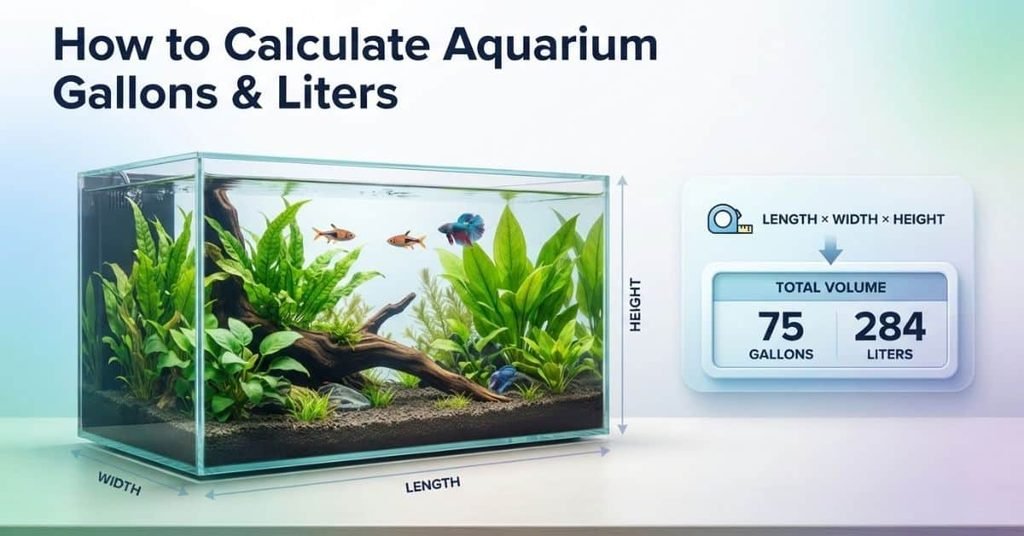
Calculating aquarium volume starts with three simple measurements: length, width, and height. For a standard rectangular aquarium, multiply these measurements together to find the tank’s volume in cubic units.
Measure the inside dimensions of the aquarium whenever possible. Start with the inside length from one end to the other. Then measure the inside width from front to back. Finally, measure the inside height from the tank bottom to the desired water level.
Keep all three measurements in the same unit. For example, use inches for all measurements if you want the result in cubic inches. Use centimeters for all measurements if you plan to calculate liters directly.
Step-by-Step Example
Suppose your aquarium measures 24 inches long, 12 inches wide, and 16 inches high.
- Multiply the length by the width:
24 × 12 = 288 - Multiply that result by the height:
288 × 16 = 4,608 - The aquarium holds 4,608 cubic inches of volume.
- Divide by 231 to convert cubic inches to U.S. gallons.
- The result is about 19.9 gallons.
This gives you the tank’s estimated capacity before accounting for substrate, decorations, or an unfilled water level.
Accurate tank volume is important when preparing a new aquarium, so check our How to Cycle Your Aquarium guide before adding fish.
Aquarium Volume Formula

A rectangular aquarium follows the standard volume formula:
Length × Width × Height
The formula works when all three measurements use the same unit. Your result first appears as a cubic measurement, such as cubic inches or cubic centimeters.
Rectangular Tank Formula
For a rectangular aquarium:
Volume = Length × Width × Height
Measure the inside dimensions for a more useful estimate. Outside measurements can slightly overstate the available space because they include glass or acrylic thickness.
Formula Using Inches
If you measure the aquarium in inches, multiply the three measurements:
Length × Width × Height = Cubic Inches
For example:
24 × 12 × 16 = 4,608 cubic inches
You can then convert the result into U.S. gallons by dividing by 231.
Formula Using Centimeters
For centimeter measurements, multiply the three dimensions to get cubic centimeters:
Length × Width × Height = Cubic Centimeters
To convert cubic centimeters into liters, divide the result by 1,000.
For example, a tank measuring 60 × 30 × 40 cm has:
60 × 30 × 40 = 72,000 cm³
Then:
72,000 ÷ 1,000 = 72 liters
Gallons and Liters Conversion
One U.S. gallon equals approximately 3.785 liters. You can multiply gallons by 3.785 to estimate liters.
For quick calculations, an aquarium volume calculator can handle these conversions automatically.
Pro Tips
- Measure from the inside of the tank.
- Keep every measurement in the same unit.
- Use the actual water height when estimating water volume.
- Remember that decorations and substrate take up space.
How to Calculate Aquarium Volume in Gallons

If you measure a rectangular aquarium in inches, you can calculate its approximate U.S. gallon capacity with one simple formula.
First, multiply the aquarium’s length × width × height. This gives you the volume in cubic inches. Then divide that number by 231, because one U.S. liquid gallon contains 231 cubic inches.
Cubic Inches to U.S. Gallons
Use this formula:
Aquarium Volume (Gallons) = Length × Width × Height ÷ 231
Make sure every measurement uses inches. Mixing inches and centimeters will give you an incorrect result.
Practical Example
Imagine an aquarium measuring 30 inches long, 12 inches wide, and 18 inches high.
First, calculate the cubic volume:
30 × 12 × 18 = 6,480 cubic inches
Next, convert cubic inches to U.S. gallons:
6,480 ÷ 231 = 28.05 gallons
So, the aquarium has an estimated capacity of about 28 gallons.
Keep in mind that this is the tank’s calculated volume, not necessarily the amount of water you will add. Gravel, rocks, driftwood, decorations, equipment, and an empty space above the water reduce the actual water volume.
Knowing your actual water volume also helps you manage the cycling process and follow our Fishless Aquarium Cycle steps correctly.
How to Calculate Aquarium Volume in Liters
Calculating aquarium volume in liters is simple when you measure the tank in centimeters. Multiply the length, width, and height together, then divide the result by 1,000.
Use this formula:
Aquarium Volume (Liters) = Length × Width × Height ÷ 1,000
Measure all three dimensions from the inside of the aquarium. Keep every measurement in centimeters to avoid conversion errors.
Practical Example
Suppose your aquarium measures 60 cm long, 30 cm wide, and 40 cm high.
First, multiply the three measurements:
60 × 30 × 40 = 72,000 cm³
Then divide by 1,000:
72,000 ÷ 1,000 = 72 liters
So, the aquarium has an estimated capacity of 72 liters.
This calculation represents the tank’s geometric volume. The actual amount of water will usually be lower after adding substrate, decorations, and other equipment.
If fish are already in your new aquarium, our Cycling Aquarium With Fish guide explains how to manage the process safely.
Pro Tips
- Measure inside the tank for a closer estimate.
- Use centimeters for every measurement.
- Use the actual water height for water-volume calculations.
- Don’t confuse tank capacity with actual water volume.
How to Calculate Aquarium Water Volume
Your aquarium’s calculated capacity isn’t always the same as its actual water volume. The difference comes from the space occupied by substrate, decorations, equipment, and unused space above the water.
Total Tank Volume vs. Actual Water Volume
Total tank volume represents the aquarium’s geometric capacity when you calculate its full dimensions.
Actual water volume represents how much water the aquarium contains after setup. This amount can be lower than the calculated capacity.
For example, a tank may calculate to about 30 gallons. However, you might fill it below the rim and add several inches of substrate. The actual water volume will then be lower.
How Gravel, Rocks, and Driftwood Affect Volume
Substrate and decorations take up physical space inside the aquarium. That space cannot hold water.
Common examples include:
- Gravel and sand
- Large rocks
- Driftwood
- Artificial decorations
- Internal equipment
The more space these items occupy, the less water the aquarium can hold.
You don’t need to remove every decoration to estimate the difference. For routine aquarium care, a reasonable water-volume estimate is often more practical.
How Water Level Affects Volume
Water height has a direct effect on aquarium volume. A lower water level means less water inside the tank.
For a more realistic calculation, measure from the tank bottom to the actual water surface. Then multiply that water height by the aquarium’s length and width.
This method gives you a better starting estimate for water changes, conditioner, and other products that require water-volume calculations.
Aquarium Volume Calculation Examples
Real tank dimensions can differ from their advertised gallon sizes. The following examples show how measurements produce approximate aquarium volumes.
10-Gallon Style Tank
Consider a tank measuring 20 × 10 × 12 inches.
20 × 10 × 12 = 2,400 cubic inches
Convert cubic inches to U.S. gallons:
2,400 ÷ 231 = 10.39 gallons
So, these dimensions produce an estimated volume of 10.4 gallons.
20-Gallon Style Tank
Now consider a tank measuring 24 × 12 × 16 inches.
24 × 12 × 16 = 4,608 cubic inches
Then:
4,608 ÷ 231 = 19.95 gallons
That gives an estimated volume of about 20 gallons.
55-Gallon Style Tank
Consider a tank measuring 48 × 13 × 20 inches.
48 × 13 × 20 = 12,480 cubic inches
Then:
12,480 ÷ 231 = 54.03 gallons
So, these dimensions produce an estimated volume of about 54 gallons.
Different Dimensions Can Produce Similar Volumes
Aquariums don’t need identical dimensions to hold similar amounts of water. A long, shallow aquarium can have a similar volume to a shorter, taller aquarium.
For example, changing the length, width, or height changes the final calculation. Always calculate volume from the actual dimensions instead of assuming the advertised tank size.
Aquarium Gallons to Liters Conversion Chart

Aquarium sizes in the USA often use U.S. gallons, while many aquarium products list measurements in liters. Knowing the conversion helps you compare tank sizes and follow product instructions correctly.
One U.S. gallon equals approximately 3.785 liters. Use the chart below for quick reference.
| Aquarium Size | Approximate Liters |
|---|---|
| 5 gallons | 18.9 liters |
| 10 gallons | 37.9 liters |
| 20 gallons | 75.7 liters |
| 30 gallons | 113.6 liters |
| 40 gallons | 151.4 liters |
| 55 gallons | 208.2 liters |
| 75 gallons | 283.9 liters |
| 100 gallons | 378.5 liters |
These figures show total equivalent volume, not necessarily the actual amount of water in a filled aquarium. Substrate, rocks, driftwood, decorations, and water level can reduce the available water volume.
For quick conversions, multiply U.S. gallons by 3.785. You can also use an aquarium volume calculator to convert gallons and liters automatically.
How to Measure an Aquarium for Volume
Accurate measurements are the foundation of a reliable aquarium volume calculation. For the best estimate, measure the aquarium’s inside dimensions rather than its outside dimensions.
Inside Length
Measure from the inside of one end panel to the inside of the opposite end panel. Keep your measuring tool straight and level.
Inside Width
Measure from the inside front panel to the inside back panel. Avoid measuring across curved edges or trim.
Inside Height
Measure from the inside bottom to the water surface or desired fill level. Use the actual water height when estimating water volume.
Use the Same Measurement Unit
Keep all three measurements in the same unit. For example, use inches for all three dimensions when calculating U.S. gallons.
For liters, you can measure all three dimensions in centimeters. Then use:
Length × Width × Height ÷ 1,000 = Liters
Why Outside Dimensions Can Cause Errors
Outside measurements include the aquarium’s glass or acrylic walls. They can also include frames, trim, or other structural parts.
That extra space doesn’t belong to the aquarium’s usable interior. Using outside dimensions can therefore make your calculated volume higher than the actual capacity.
For most rectangular tanks, inside measurements provide a more useful estimate.
What About Irregular-Shaped Aquariums?
The standard Length × Width × Height formula works best for rectangular aquariums. Irregular shapes require different methods because their dimensions don’t form a simple rectangular box.
Bow-Front Tanks
Bow-front aquariums have a curved front panel. A rectangular formula can overestimate their volume because part of the calculated space doesn’t match the curved shape.
You can use the tank manufacturer’s stated capacity as a starting point. For greater accuracy, estimate the curved section separately or use a calculator designed for that shape.
Corner Tanks
Corner aquariums often have triangular or curved layouts. Their volume depends on the exact shape and dimensions.
A basic rectangular calculation may provide only a rough estimate.
Cylindrical Tanks
Cylindrical aquariums require a different formula:
Volume = π × radius² × height
You can then convert the result into liters or gallons.
Approximation Limitations
Irregular tanks make volume calculations more complicated. Curves, angled panels, rounded corners, and unusual bases can all affect the result.
For simple rectangular aquariums, the standard formula remains the easiest and most reliable approach.
When accuracy matters, follow the manufacturer’s capacity or use measurements that match the tank’s actual shape.
Why Knowing Aquarium Volume Matters
Knowing your aquarium’s volume helps you make better decisions about routine fish care. Many aquarium products and maintenance tasks depend on the amount of water in the tank.
Water Conditioner Dosing
Water conditioners often provide dosing instructions based on water volume. An accurate estimate helps you avoid guessing the amount needed.
Medication
Aquarium medications can also require specific doses based on water volume. Follow the product label carefully and use the most accurate practical estimate available.
Water Changes
Knowing your tank’s volume makes water-change calculations easier. For example, you can determine how much water a 25% or 50% change represents.
Heater Selection
Aquarium volume provides an important starting point when choosing a heater. However, room temperature, tank placement, and the desired temperature also affect heater needs.
Filter Selection
Tank volume helps you compare filter options and their recommended aquarium sizes. Consider the aquarium’s inhabitants and maintenance needs as well.
Stocking
Aquarium volume gives you useful context when planning livestock. However, stocking decisions should also consider species size, behavior, compatibility, filtration, and swimming space.
Takeaways
Accurate volume information supports safer aquarium maintenance. It helps you make better decisions instead of relying on guesswork.
Use Our Aquarium Volume Calculator
Don’t want to calculate aquarium volume manually? Our Aquarium Volume Calculator can make the process much faster.
Enter your aquarium’s length, width, and height into the calculator. Make sure all measurements use the same unit before calculating.
The tool can quickly estimate your aquarium volume and help you understand the tank’s capacity in common measurements.
For the most useful result, measure the inside of your aquarium before entering the dimensions. Remember that substrate, decorations, and a lower water level can reduce the actual amount of water.
Ready to calculate your tank size? Use our Aquarium Volume Calculator to get your estimated aquarium volume without doing the math manually.
Conclusion
Calculating your tank’s volume starts with three simple measurements: length, width, and height. You can then convert the result into U.S. gallons or liters using the right formula.
Knowing how to calculate aquarium volume helps you manage water changes, conditioner, medication, filtration, heating, and stocking decisions. Remember that actual water volume can be lower than the tank’s calculated capacity. Gravel, rocks, driftwood, decorations, and water level all affect the final amount.
For rectangular aquariums, the standard formula provides a simple and useful estimate. If you want faster results, use our Aquarium Volume Calculator to calculate your tank size in seconds.
Have a different tank shape or calculation tip? Share your experience in the comments and explore more aquarium guides on our website.
Frequently Asked Questions
For a rectangular aquarium, multiply the length × width × height. Use the same measurement unit for all three dimensions. If you measure in inches, divide the result by 231 to get approximate U.S. gallons. If you measure in centimeters, divide the result by 1,000 to get liters. Use inside dimensions for a more useful estimate.
Measure the aquarium’s inside length and width, then measure from the bottom to the actual water level. Multiply these three measurements together. This gives a better estimate of the water volume than using the tank’s full height. Substrate, rocks, driftwood, decorations, and equipment also reduce the actual amount of water.
Measure the tank’s length, width, and height in inches. Multiply the three measurements together to find cubic inches. Then divide the result by 231.
This formula works best for standard rectangular aquariums.
Measure the aquarium’s length, width, and height in centimeters. Multiply all three measurements together, then divide by 1,000.
For example, a 60 × 30 × 40 cm aquarium holds approximately 72 liters based on its calculated dimensions.
A calculation based on inside dimensions gives a useful estimate for a rectangular aquarium. However, the actual water volume can be lower. Water level, substrate, rocks, driftwood, decorations, and equipment all take up space. Irregular-shaped tanks can also require different calculation methods.
No. The basic aquarium volume formula calculates the tank’s geometric capacity. It does not automatically subtract gravel, sand, rocks, driftwood, or decorations.
These items occupy space that would otherwise hold water. Therefore, actual water volume is usually lower than the calculated tank capacity.
For a rectangular fish tank, measure the inside length, width, and height. Multiply the three measurements together.
For gallons, divide the result by 231 when using inches. For liters, divide the result by 1,000 when using centimeters. For irregular tanks, such as bow-front or cylindrical aquariums, use a shape-specific calculation.
Measure the inside dimensions whenever possible. Outside measurements include the thickness of the glass or acrylic.
Frames, trim, and other external parts can also affect the measurement. Using outside dimensions may produce a higher volume estimate than the tank’s actual interior capacity.
Aquarium volume refers to the tank’s calculated capacity based on its dimensions. Water volume refers to the amount of water actually inside the aquarium.
The actual water volume can be lower because of substrate, decorations, equipment, and an incomplete fill level.
Yes. Centimeters work well for calculating liters. Multiply the length, width, and height in centimeters. Then divide the result by 1,000.
72,000 ÷ 1,000 = 72 liters
Yes. Inches work well when calculating U.S. gallons. Multiply the length, width, and height in inches. Then divide the result by 231.
4,608 ÷ 231 = about 20 gallons
You can use the advertised size as a general reference. However, it may not represent the exact amount of water in your setup.
Your actual water volume depends on the tank’s interior dimensions, water level, substrate, decorations, and other items inside the aquarium.
Irregular aquariums need different approaches depending on their shape. Bow-front and corner tanks may require an approximation based on their specific dimensions.
Cylindrical tanks use a different formula based on radius and height. If your aquarium has an unusual shape, the manufacturer’s stated capacity or a shape-specific calculator can provide a better estimate.
Yes. An aquarium volume calculator can simplify the calculation process. Enter the aquarium’s length, width, and height using the required measurement unit.
The calculator can then convert the dimensions into an estimated volume. For best results, measure the inside of the aquarium and use the actual water height when estimating water volume.
Pro Tip: Use the Aquarium Volume Calculator for a faster estimate, then account for substrate and decorations when you need the actual water volume.

The Aquarium Advisor Team was founded by Daniel Carter (Austin, Texas, USA) and Emily Parker (Tampa, Florida, USA), two passionate aquarium enthusiasts dedicated to helping hobbyists build healthy and thriving aquariums.
They created AquariumAdvisor.com to share practical aquarium guides and professional online calculators. Every calculator is developed with experienced software developers to ensure accurate, reliable, and easy-to-use results for aquarium owners of all experience levels.