
Table of Contents
Introduction
Have you ever wondered why some home aquariums stay crystal clear while others struggle with constant algae and unhealthy fish?
A planted aquarium setup is one of the best ways to create a healthier, more natural environment for your fish. More beginners across the USA are choosing planted tanks because they improve water quality, reduce maintenance, and add beautiful greenery to any space. While the process may seem overwhelming at first, learning how to setup a planted aquarium is much easier when you follow the right steps.
In this beginner-friendly guide, you’ll learn everything you need to build a thriving planted aquarium from the ground up. We’ll cover the essential equipment, the best beginner plants, substrate options, lighting, cycling, maintenance, and common mistakes to avoid. You’ll also discover how to setup a planted aquarium without CO2 if you want a simple, low-maintenance tank. By the end, you’ll have the confidence to create a healthy planted aquarium that looks great and supports happy, thriving fish.
How do you set up a planted aquarium?
A planted aquarium setup starts with choosing the right tank, adding a nutrient-rich substrate, and installing a filter, heater, and suitable lighting. Next, plant easy-care aquatic plants, treat the water with a conditioner, cycle the aquarium before adding fish, and perform regular maintenance to keep your planted tank healthy and thriving.
What Is a Planted Aquarium?
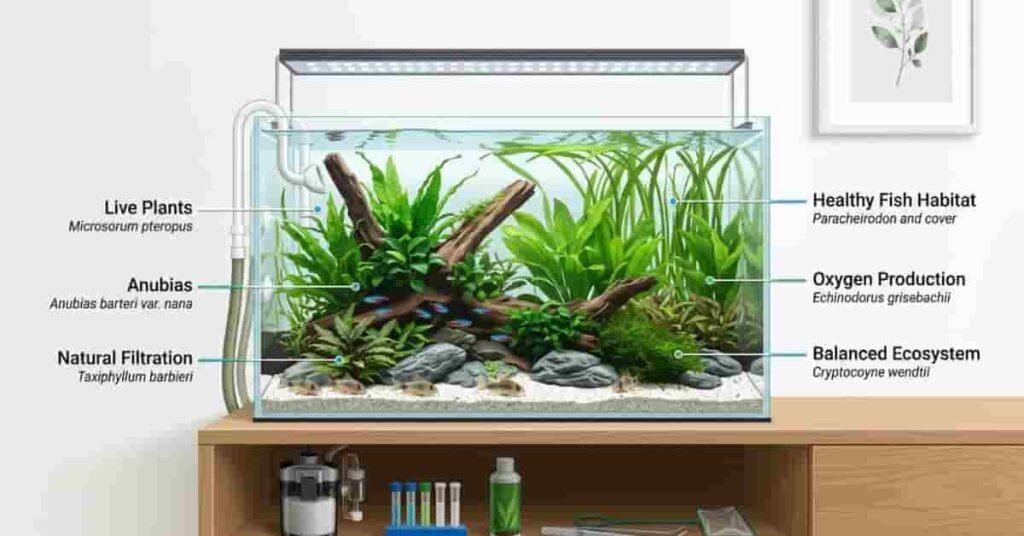
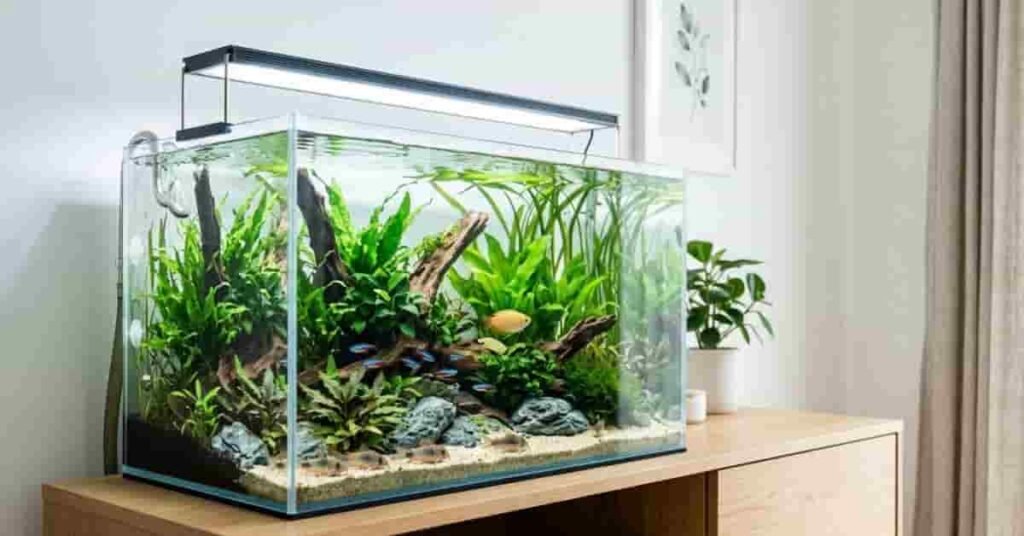
A planted aquarium is a freshwater fish tank that uses live aquatic plants instead of only artificial decorations. In a planted aquarium setup, the plants work alongside the filter to create a healthier and more natural environment for fish. They absorb nutrients from the water, release oxygen during the day, and help keep the aquarium balanced.
Filtration is an important part of maintaining clear water and healthy conditions in a planted aquarium. Our Aquarium Filter Setup Guide explains how to choose and set up the right filter for your tank.
Unlike a traditional aquarium with plastic plants, a planted tank looks and functions more like a natural underwater ecosystem. The combination of live plants, suitable substrate, lighting, and filtration creates a stable habitat that supports both plant growth and fish health. Beginners often worry that live plants are difficult to maintain, but many hardy species grow well with basic care and do not require advanced equipment.
Many hobbyists in the USA choose planted aquariums because they improve the tank’s appearance while making routine maintenance easier over time. Whether you want a small desktop aquarium or a larger community tank, a planted aquarium offers a rewarding way to enjoy fishkeeping.
Takeaways
- Live plants create a more natural aquarium environment.
- Plants help support healthy fish and stable water conditions.
- Many beginner-friendly plants are easy to grow.
- A well-planned planted tank can require less maintenance over time.
Benefits of a Planted Aquarium
A planted aquarium offers more than just attractive scenery. Live plants improve the aquarium’s environment and make it more comfortable for fish. They also help beginners create a healthier tank with fewer common problems.
Some of the biggest benefits include:
- Healthier fish: Live plants provide shelter, reduce stress, and create a habitat that feels more natural for many freshwater fish.
- Better water quality: Plants absorb nutrients such as nitrate, helping maintain cleaner water when combined with regular maintenance.
- Natural appearance: Green plants, rocks, and driftwood create a beautiful underwater landscape that looks more realistic than plastic decorations.
- Reduced algae: Healthy plants compete with algae for nutrients, which can help limit algae growth when lighting and fertilization stay balanced.
Who Should Choose a Planted Tank?
A planted tank is an excellent choice for anyone who wants a beautiful aquarium that also supports fish health. It works well for beginners because many live plants are hardy and easy to care for. You don’t need expensive equipment or advanced experience to get started.
A planted aquarium is a great fit if you:
- Are setting up your first freshwater aquarium.
- Want a natural-looking tank instead of plastic decorations.
- Prefer low-maintenance plants that are easy to grow.
- Plan to keep peaceful community fish.
- Are interested in learning more about the aquarium hobby over time.
Many first-time aquarium owners believe live plants are difficult to maintain. In reality, starting with beginner-friendly plants, proper lighting, and a simple maintenance routine makes success much easier. As your confidence grows, you can always add new plants and experiment with more advanced aquascaping techniques.
Pro Tip
Start with a 20-gallon planted aquarium if you have the space. Larger tanks are usually more stable, making them easier for beginners to maintain.
What You Need Before Setting Up a Planted Aquarium
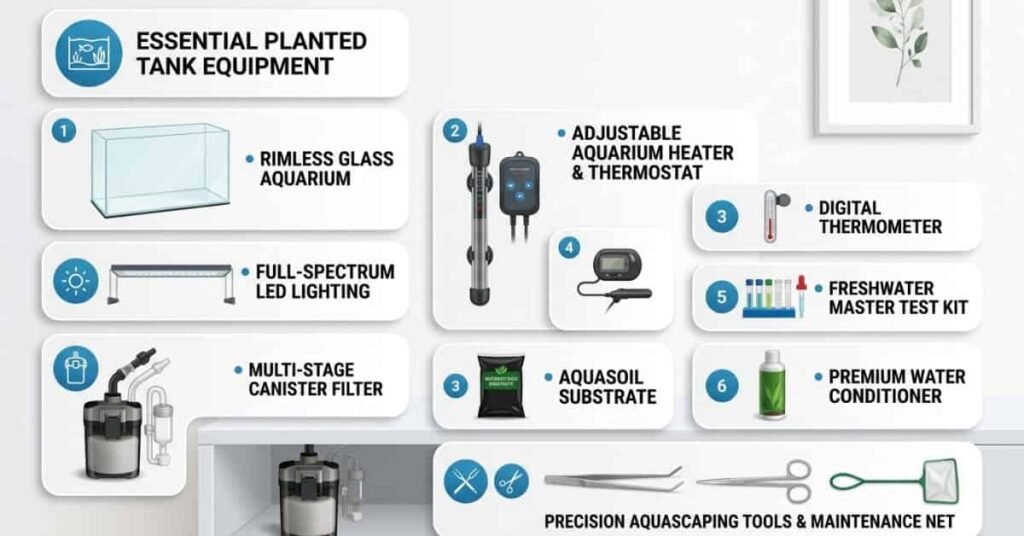
A successful planted aquarium setup begins with choosing the right equipment. Buying quality essentials before you start saves time, prevents common mistakes, and creates a healthier environment for both plants and fish. While it’s tempting to focus only on plants, every piece of equipment plays an important role in keeping the tank stable.
Larger planted aquariums may benefit from the additional filtration capacity and equipment space provided by a sump. See our Aquarium Sump Setup Guide to learn how a sump system works.
The good news is that beginners don’t need the most expensive gear. A properly sized aquarium, reliable filter, suitable lighting, nutrient-rich substrate, and a few basic supplies are enough to grow many popular aquarium plants. If you’re learning how to setup a planted freshwater aquarium, investing in the right equipment from the beginning will make maintenance much easier.
Beginner Equipment Checklist
| Equipment | Required | Why It Matters |
|---|---|---|
| Aquarium | ✅ Yes | Provides space for fish and plants |
| Aquarium Stand | ✅ Yes | Safely supports the tank’s weight |
| LED Lighting | ✅ Yes | Helps plants grow through photosynthesis |
| Filter | ✅ Yes | Keeps water clean and oxygenated |
| Heater | ✅ For tropical tanks | Maintains a stable temperature |
| Plant Substrate | ✅ Yes | Supplies nutrients and supports roots |
| Water Conditioner | ✅ Yes | Removes harmful chlorine and chloramine |
| Aquarium Test Kit | ✅ Yes | Monitors water quality during cycling |
Choosing dependable equipment from the start helps create a stable aquarium that is easier to maintain. It also reduces the chances of algae problems, unhealthy plants, and stressed fish.
Choosing the Right Aquarium Size
Tank size is one of the most important decisions you’ll make. Many beginners think a small aquarium is easier to maintain, but the opposite is often true. Larger tanks hold more water, making temperature and water quality more stable.
For most beginners, a 20-gallon aquarium offers the best balance between cost, maintenance, and stocking options. It provides enough room for live plants to grow while giving fish plenty of swimming space. A 10-gallon tank can also work if you have limited space, but it requires closer attention to water quality.
If your budget allows, avoid tanks smaller than five gallons. They can become unstable quickly and leave little room for planting.
Pro Tip
A 20-gallon aquarium gives beginners more room for mistakes because water conditions change more slowly than in smaller tanks.
Aquarium Stand
An aquarium becomes surprisingly heavy once it is filled with water, substrate, rocks, and decorations. A proper aquarium stand is designed to support that weight safely for years.
Choose a stand made specifically for your aquarium size. It should sit on a flat, level surface and leave enough room underneath for maintenance supplies or external equipment if needed. Avoid placing a filled aquarium on ordinary furniture unless the manufacturer confirms it can support the weight.
Also keep the aquarium away from direct sunlight, heating vents, and frequently opened windows. These locations can cause temperature swings and encourage unwanted algae growth.
Pro Tip
Always check that your stand is perfectly level before filling the aquarium. Even a slight tilt can place uneven pressure on the glass.
Aquarium Lighting
Light is essential because aquarium plants use it to produce energy through photosynthesis. Without proper lighting, even hardy plants may struggle to grow.
Most beginners should choose a full-spectrum LED aquarium light. LED fixtures are energy-efficient, produce little heat, and provide the light most aquatic plants need. Aim for about 6 to 8 hours of light each day when starting a new planted tank. Longer lighting periods often encourage algae before plants become established.
Using a timer makes it easier to keep a consistent lighting schedule.
Pro Tip
Avoid leaving aquarium lights on all day. Consistent lighting is more important than long lighting hours.
Aquarium Filter
A filter keeps water clean by removing waste, circulating oxygen, and providing a home for beneficial bacteria. These bacteria break down harmful ammonia and nitrite, helping create a healthy aquarium.
Hang-on-back (HOB) filters and sponge filters are excellent choices for beginners. They provide gentle water flow and are easy to maintain. When choosing a filter, make sure it matches your aquarium’s size and water volume.
Never replace all filter media at the same time. Doing so can remove beneficial bacteria that help keep the aquarium stable.
Pro Tip
Rinse filter media with old aquarium water during maintenance, not tap water. This helps protect beneficial bacteria.
Aquarium Heater
If you plan to keep tropical freshwater fish, a reliable heater is essential. Most tropical species thrive in water temperatures between 72°F and 78°F (22°C–26°C).
Choose an adjustable heater designed for your aquarium’s size. Pair it with a separate aquarium thermometer so you can monitor the temperature daily. Stable temperatures reduce stress and support healthy plant and fish growth.
Cold-water fish may not require a heater, but always check the needs of your chosen species before setting up the tank.
Pro Tip
Place the heater near the filter outlet so warm water circulates evenly throughout the aquarium.
Aquarium Substrate
The substrate forms the foundation of your planted aquarium. It anchors plant roots and, depending on the type, provides nutrients that support healthy growth.
Nutrient-rich aquarium soil is the best option for most planted tanks because it supplies essential nutrients directly to plant roots. Gravel and sand can also work, but they usually require root tabs to support heavy root-feeding plants like Amazon Sword and Cryptocoryne.
Choose a substrate depth of about 2 to 3 inches to give plants enough room to develop strong root systems.
Pro Tip
Use aquarium soil if your budget allows. It gives beginner plants the best chance to grow successfully.
Water Conditioner
Tap water often contains chlorine or chloramine to make it safe for people, but these chemicals can harm fish and beneficial bacteria.
Always add a water conditioner before introducing tap water into your aquarium. Most conditioners work within minutes and make the water safe for plants and aquatic life. Follow the dosage instructions on the product label carefully.
Never add untreated tap water directly to your planted aquarium.
Pro Tip
Keep a bottle of water conditioner near your aquarium so you never forget to treat water during water changes.
Aquarium Test Kit
An aquarium test kit helps you monitor water quality before and after adding fish. It is especially important while the aquarium is cycling because harmful ammonia and nitrite levels can rise quickly.
A good freshwater test kit should measure:
- Ammonia
- Nitrite
- Nitrate
- pH
Testing the water regularly helps you spot problems early and make adjustments before fish or plants are affected.
Best Plants for Beginners
Choosing the right plants is one of the most important parts of a successful planted aquarium setup. As a beginner, start with hardy species that can tolerate small mistakes while your aquarium matures. Many easy-care plants grow well under standard LED lighting and don’t require a CO₂ system, making them perfect if you’re learning how to setup a low-tech planted aquarium.
If you eventually want to explore a different type of aquarium, marine tanks offer a completely different setup and maintenance experience. Our Marine Aquarium Setup Guide explains how beginners can get started with a saltwater aquarium.
The best beginner plants grow slowly, adapt to different water conditions, and need only basic care. They also help improve water quality, provide hiding places for fish, and create a lush, natural-looking aquarium. By starting with these low-maintenance aquarium plants, you’ll build confidence before trying more demanding species.
Best Beginner Aquarium Plants
| Plant | Difficulty | Light Requirement | CO₂ Needed | Best Placement |
|---|---|---|---|---|
| Java Fern | Easy | Low to Moderate | No | Midground or attached to wood and rocks |
| Anubias | Easy | Low | No | Foreground or attached to hardscape |
| Amazon Sword | Easy | Moderate | No | Background |
| Java Moss | Easy | Low | No | Rocks, driftwood, or carpet accents |
| Vallisneria | Easy | Moderate | No | Background |
| Cryptocoryne | Easy | Low to Moderate | No | Foreground or Midground |
Java Fern
Java Fern is one of the easiest aquarium plants for beginners. It thrives in low to moderate light and grows well without added CO₂. Instead of planting it in the substrate, attach it to driftwood or rocks using aquarium-safe thread or glue. Burying its rhizome can cause the plant to rot.
Its slow growth means less pruning, making it an excellent choice for low-maintenance planted tanks.
Anubias
Anubias is another hardy plant that tolerates a wide range of water conditions. Like Java Fern, it grows best when attached to rocks or driftwood instead of being buried in the substrate.
Its thick, dark green leaves are attractive and durable. Because it grows slowly, Anubias needs very little maintenance and is ideal for beginners who want a long-lasting plant.
Amazon Sword
Amazon Sword is a popular background plant known for its large, bright green leaves. It grows from the substrate and develops an extensive root system, so it benefits from nutrient-rich aquarium soil or root tabs.
With proper lighting and nutrients, this plant becomes a beautiful centerpiece in medium and large planted aquariums.
Java Moss
Java Moss is incredibly versatile and almost impossible for beginners to kill. It can grow on rocks, driftwood, decorations, or mesh to create a natural carpet-like effect.
Many shrimp and small fish enjoy hiding in its dense growth. Occasional trimming helps maintain its shape and prevents it from spreading too far.
Vallisneria
Vallisneria produces long, ribbon-like leaves that sway naturally in the water current. It grows quickly and spreads by sending out runners, making it easy to fill the background of an aquarium.
This plant prefers moderate lighting and adapts well to most freshwater community tanks.
Cryptocoryne
Cryptocoryne, often called “Crypts,” is a favorite among beginner aquarists because of its attractive leaf shapes and low maintenance needs. After planting, it may temporarily lose some leaves, a normal process known as Crypt melt. New healthy leaves usually appear once the plant adjusts to its new environment.
Cryptocoryne grows best in nutrient-rich substrate and works well in the foreground or midground of a planted aquarium.
How to Set Up a Planted Aquarium (Step-by-Step)
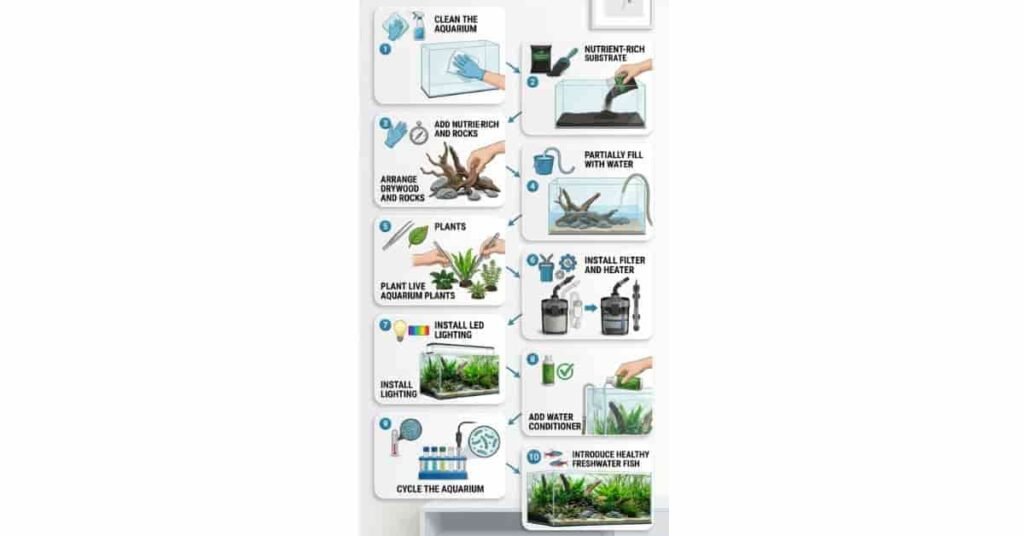
A successful planted aquarium setup doesn’t require expensive equipment or years of experience. The key is following each step in the right order. Rushing the process can lead to cloudy water, unhealthy plants, algae growth, or stressed fish.
If you’re wondering how to setup a planted aquarium, this beginner-friendly guide walks you through every stage. By the time you finish, you’ll have a healthy freshwater aquarium that’s ready to support thriving plants and fish.
Step 1 – Clean the Tank
Start by rinsing the aquarium with clean, lukewarm water. Remove any dust or debris left from manufacturing or storage. If you’re using rocks, driftwood, or decorations, rinse those as well before placing them in the tank.
Never use soap, bleach, or household cleaners. Even small traces of cleaning chemicals can harm fish and beneficial bacteria.
Pro Tip: Wipe the glass with a clean microfiber cloth before adding the substrate for a spotless finish.
Step 2 – Add Nutrient-Rich Substrate
The substrate forms the foundation of your planted aquarium. It anchors plant roots and supplies nutrients needed for healthy growth.
Spread a 2 to 3-inch layer of nutrient-rich aquarium soil across the bottom of the tank. For a more natural appearance, make the substrate slightly deeper at the back than the front. This creates depth and improves water circulation around plant roots.
If you’re using gravel or sand, consider adding root tabs beneath heavy root-feeding plants like Amazon Sword.
Pro Tip: Slope the substrate toward the back of the aquarium to create a more attractive aquascape.
Step 3 – Position Hardscape
Now arrange your hardscape materials, such as driftwood, natural rocks, and decorative stones. These elements provide structure and create hiding places for fish.
Take your time with this step because moving heavy decorations after planting can disturb roots and cloud the water. Leave open swimming areas while creating natural-looking spaces for plants.
A simple layout often looks better than an overcrowded design.
Pro Tip: Test different layouts outside the aquarium first until you find one you like.
Step 4 – Fill Water Carefully
Add only enough water to cover the substrate by a few inches before planting. Pour the water slowly onto a small plate, plastic bag, or bowl placed on the substrate. This prevents the soil from being disturbed.
Once the plants are in place, continue filling the aquarium until it reaches the desired level.
Taking your time during this step helps keep the water much clearer.
Pro Tip: Use room-temperature water to reduce stress on both plants and future fish.
Step 5 – Plant Aquarium Plants Properly
If you’re learning how to setup live plants in aquarium, proper planting is one of the most important skills to master.
Remove each plant from its pot and gently rinse away any growing material around the roots. Trim damaged leaves or excessively long roots if necessary.
Plant rooted species, such as Amazon Sword, Vallisneria, and Cryptocoryne, directly into the substrate while keeping the crown above the surface. Attach rhizome plants like Java Fern and Anubias to rocks or driftwood instead of burying them.
For the best visual balance:
- Foreground: Anubias, Cryptocoryne
- Midground: Java Fern
- Background: Amazon Sword, Vallisneria
- Hardscape: Java Moss
Arrange taller plants toward the back and shorter plants near the front to create depth and leave enough swimming space for fish.
Pro Tip: Plant heavily from the beginning. More live plants help absorb excess nutrients and reduce the chance of algae during the first few weeks.
Step 6 – Install Filter & Heater
Once the plants are in place, install the filter and heater according to the manufacturer’s instructions.
Position the heater near the filter outlet so warm water circulates evenly throughout the aquarium. Ensure the filter provides gentle water movement without creating strong currents that may uproot new plants.
Double-check that all equipment is secure before plugging it in.
Pro Tip: Wait until the heater is fully submerged before turning it on to avoid damaging the unit.
Step 7 – Install Lighting
Install a full-spectrum LED aquarium light above the tank. Most beginner-friendly plants grow well with 6 to 8 hours of light each day.
Using a timer helps maintain a consistent lighting schedule and prevents accidentally leaving the lights on too long.
Too much light during the early weeks can encourage algae before plants become fully established.
Step 8 – Add Water Conditioner
Before the aquarium is ready for fish, treat the water with a quality water conditioner. This removes chlorine and chloramine commonly found in tap water.
Follow the dosage instructions provided by the manufacturer. Adding untreated tap water can damage beneficial bacteria and stress future fish.
Every water change should include water conditioner.
Step 9 – Cycle the Aquarium
Cycling is one of the most important steps in a planted aquarium setup. During this process, beneficial bacteria grow inside the filter and substrate. These bacteria convert harmful ammonia into nitrite and then into the less harmful nitrate.
This process usually takes several weeks, depending on the cycling method and aquarium conditions. Use an aquarium test kit to monitor ammonia, nitrite, and nitrate levels regularly.
Do not add fish until the nitrogen cycle is complete.
Step 10 – Add Fish
After the aquarium has fully cycled, begin adding fish gradually instead of introducing all of them at once. This gives the biological filter time to adjust to the increasing waste load.
Choose peaceful freshwater species that are compatible with live plants. Observe your fish closely during the first few days and continue testing the water to ensure stable conditions.
A slow and careful introduction helps create a healthy, long-lasting planted aquarium.
Takeaways
- Follow the setup steps in order without skipping any stage.
- Plant live plants before fully filling the aquarium.
- Use quality equipment and a nutrient-rich substrate.
- Cycle the aquarium completely before adding fish.
- Add fish slowly to keep the aquarium stable.
How to Set Up a Low-Tech Planted Aquarium
If you’re wondering how to setup a low-tech planted aquarium, the good news is that you don’t need expensive equipment to grow healthy aquatic plants. A low-tech planted tank relies on natural plant growth, basic equipment, and simple maintenance instead of pressurized CO₂ systems. It’s an excellent choice for beginners because it’s affordable, easy to manage, and forgiving of small mistakes.
Most low-tech aquariums use hardy plants that grow well under moderate lighting and absorb nutrients from the water or substrate. With a good filter, quality substrate, and a consistent care routine, you can create a beautiful planted aquarium that stays healthy for years.
No CO₂ Required
One of the biggest advantages of a low-tech planted aquarium is that it doesn’t require a pressurized CO₂ system. While additional CO₂ can speed up plant growth, many beginner-friendly plants thrive without it.
Plants such as Java Fern, Anubias, Java Moss, Vallisneria, and Cryptocoryne grow successfully using the natural carbon dioxide already present in the water. This makes the setup simpler, reduces equipment costs, and lowers the chance of algae caused by unstable CO₂ levels.
If you’re just starting the hobby, focus on keeping water conditions stable instead of adding extra equipment.
Beginner Lighting
Lighting has a major impact on plant health. For a low-tech aquarium, a full-spectrum LED light is usually the best option. It provides enough light for hardy plants without encouraging excessive algae growth.
Aim for 6 to 8 hours of lighting each day and use a timer to keep the schedule consistent. Avoid leaving the lights on longer, especially during the first few weeks, because too much light often causes algae before plants become established.
You don’t need a high-powered lighting system for easy-care plants. Moderate lighting is usually enough.
Easy Plants for a Low-Tech Aquarium
Choosing the right plants makes maintenance much easier. Start with species that tolerate a wide range of water conditions and grow well without added CO₂.
Some of the best low-maintenance options include:
- Java Fern – Slow-growing and ideal for rocks or driftwood.
- Anubias – Hardy, durable, and perfect for beginners.
- Java Moss – Grows on almost any surface and provides shelter for small fish.
- Vallisneria – Creates a lush background with long, flowing leaves.
- Cryptocoryne – Adapts well after an initial adjustment period.
- Amazon Sword – A great background plant for medium and large aquariums.
These plants require little attention and help create a healthy, natural-looking aquarium.
Low Maintenance Tips
A low-tech planted aquarium is easier to maintain because plant growth is slower and equipment is simpler. Even so, regular care is still important to keep the tank healthy.
Follow these basic maintenance practices:
- Change 20–30% of the water each week.
- Remove dead or damaged leaves during maintenance.
- Clean the aquarium glass when algae appears.
- Test water regularly, especially in a new aquarium.
- Avoid overfeeding fish to reduce excess nutrients.
- Trim plants only when they become overgrown.
Expert Tip
Many beginners believe adding more equipment guarantees better results. In reality, a stable routine, healthy plants, and patience are far more important than expensive upgrades. Master a low-tech setup first, then consider advanced equipment only if your plants truly need it.
How to Set Up a Planted Aquarium Without CO₂
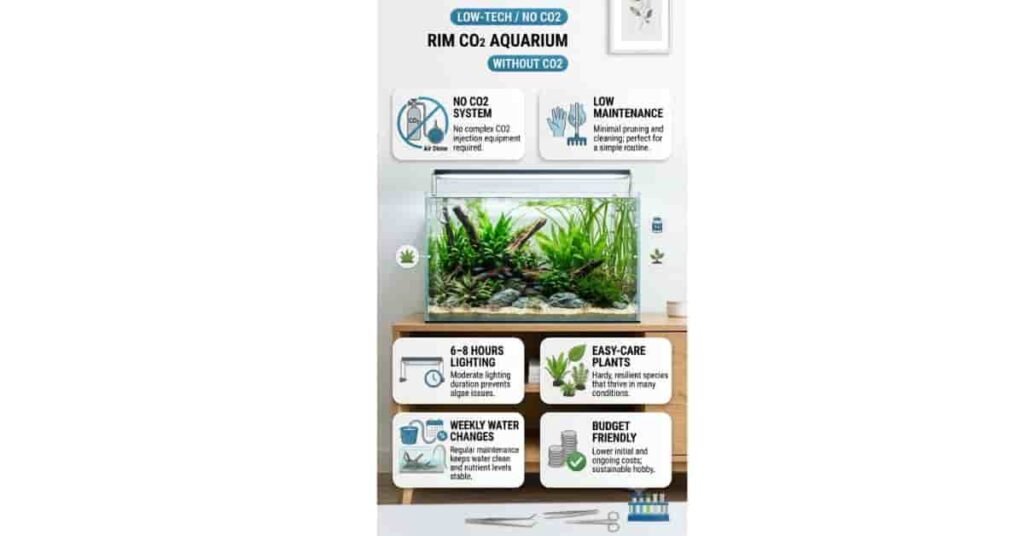
Learning how to setup a planted aquarium without CO2 is easier than many beginners expect. While pressurized CO₂ can boost plant growth, it isn’t necessary for many popular aquarium plants. With the right lighting, nutrient-rich substrate, and a simple maintenance routine, you can grow a beautiful planted aquarium without investing in extra equipment.
A no-CO₂ setup is ideal for beginners because it’s more affordable and easier to maintain. Plant growth is slower, which means less pruning and a lower risk of algae caused by imbalances. The key is choosing hardy plants that naturally thrive in low-tech conditions.
Best Plants That Grow Without CO₂
Many aquatic plants grow well using the natural carbon dioxide already dissolved in the water. These species are hardy, adaptable, and perfect for first-time aquarium owners.
Some of the best no-CO₂ plants include:
| Plant | Growth Rate | Light Requirement | Beginner Friendly |
|---|---|---|---|
| Java Fern | Slow | Low to Moderate | ✅ Yes |
| Anubias | Slow | Low | ✅ Yes |
| Java Moss | Moderate | Low | ✅ Yes |
| Cryptocoryne | Slow | Low to Moderate | ✅ Yes |
| Vallisneria | Moderate | Moderate | ✅ Yes |
| Amazon Sword | Moderate | Moderate | ✅ Yes |
These plants require little care and adapt well to most freshwater community aquariums. Combining several species also creates a more natural and balanced aquascape.
Lighting Recommendations
Good lighting is essential, even without CO₂. Most beginner plants grow best under a full-spectrum LED aquarium light that provides moderate brightness.
A lighting schedule of 6 to 8 hours per day is enough for most no-CO₂ planted tanks. Using a timer helps maintain a consistent routine and reduces the chance of algae caused by irregular lighting.
Avoid assuming that brighter or longer lighting will produce faster plant growth. Without additional CO₂, excessive light often encourages algae instead of healthier plants.
Simple Fertilizer Schedule
Although plants can survive without added CO₂, they still need nutrients to grow well. The right fertilizer schedule depends on your substrate and the types of plants you keep.
A simple routine for beginners is:
- Liquid fertilizer: Add 1–2 times per week according to the product’s instructions.
- Root tabs: Replace every 2–3 months for heavy root-feeding plants like Amazon Sword and Cryptocoryne.
- Water changes: Change 20–30% of the water each week to maintain nutrient balance.
Always follow the fertilizer manufacturer’s recommended dosage. Adding more fertilizer than needed won’t speed up growth and may encourage algae.
Common Mistakes to Avoid
Many beginner problems come from trying to force plants to grow too quickly. A stable routine produces better results than constant adjustments.
Avoid these common mistakes:
- Leaving the lights on for more than 8 hours each day.
- Choosing demanding plants that require high light and CO₂.
- Overdosing liquid fertilizers.
- Skipping weekly water changes.
- Burying the rhizomes of Java Fern or Anubias.
- Adding too many fish before the aquarium finishes cycling.
- Expecting rapid plant growth during the first few weeks.
Best Substrate for Planted Aquariums
The substrate is the foundation of any planted aquarium setup. It anchors plant roots, stores nutrients, and influences how well your plants grow over time. Choosing the right substrate from the start can make plant care much easier, especially if you’re setting up your first planted aquarium.
There isn’t a single substrate that’s perfect for every aquarium. The best choice depends on your budget, the plants you want to grow, and the level of maintenance you’re comfortable with. For most beginners, aquarium soil (also called aquasoil) offers the best balance of plant growth and ease of use. However, gravel, sand, and nutrient substrates can also work when paired with the right fertilizers.
Substrate Comparison
| Substrate | Best For | Plant Growth | Nutrients | Maintenance | Beginner Friendly |
|---|---|---|---|---|---|
| Aqua Soil | Most planted aquariums | Excellent | High | Moderate | ⭐⭐⭐⭐⭐ |
| Gravel | Low-tech tanks | Good* | Low | Easy | ⭐⭐⭐⭐☆ |
| Sand | Natural aquascapes | Fair* | Very Low | Moderate | ⭐⭐⭐☆☆ |
| Nutrient Substrate | Heavily planted tanks | Excellent | High | Moderate | ⭐⭐⭐⭐☆ |
*Gravel and sand usually require root tabs for heavy root-feeding plants.
Aqua Soil
Aqua soil is the preferred choice for many planted aquarium hobbyists because it contains nutrients that support healthy root development. It also helps anchor plants and often creates conditions that encourage strong growth.
This substrate works especially well for plants like Amazon Sword, Cryptocoryne, and Vallisneria. Although it costs more than gravel or sand, many beginners find the improved plant growth worth the investment.
Pros
- Rich in nutrients
- Supports strong root growth
- Excellent for most aquatic plants
- Ideal for planted aquariums
Cons
- Higher upfront cost
- Can temporarily cloud the water during setup
Gravel
Gravel is one of the most common aquarium substrates because it is affordable, easy to clean, and available in many sizes and colors. While it doesn’t naturally contain nutrients, it can still support healthy plants when combined with root tabs or liquid fertilizers.
Rounded gravel is generally better than sharp gravel because it is gentler on plant roots and bottom-dwelling fish.
Pros
- Budget-friendly
- Easy to maintain
- Available almost everywhere
- Good water circulation around roots
Cons
- Contains very few nutrients
- Heavy root-feeding plants need additional fertilization
Sand
Sand creates a clean, natural appearance and is popular in aquascapes with corydoras, loaches, and other bottom-dwelling fish. However, fine sand can become compacted over time, making it harder for plant roots to spread.
If you choose sand, stir open areas gently during maintenance and use root tabs to supply nutrients for rooted plants.
Pros
- Natural appearance
- Soft for bottom-dwelling fish
- Affordable and widely available
Cons
- Low nutrient content
- Can compact around plant roots
- Requires extra care for healthy plant growth
Nutrient Substrate
Nutrient substrates are designed specifically for planted aquariums. They contain minerals and nutrients that support root development for months after setup. Some hobbyists use them as a base layer beneath gravel or sand, while others choose products that can be used on their own.
This option is well suited for aquariums with many live plants and species that feed heavily through their roots.
Pros
- Rich in nutrients
- Promotes vigorous plant growth
- Long-lasting nutrient supply
Cons
- Usually more expensive than gravel or sand
- Some products require a decorative top layer
Which Substrate Is Best for Beginners?
For most first-time aquarium owners, aqua soil is the best overall choice because it gives plants the nutrients they need from day one. If you’re working with a smaller budget, gravel with root tabs is an excellent alternative that can still produce healthy plant growth.
Sand is a good option if you prefer a natural-looking aquarium or plan to keep bottom-dwelling fish, but it usually requires more attention to plant nutrition.
Expert Tip
Don’t choose a substrate based only on appearance. Think about the plants you want to grow. Root-feeding plants benefit from nutrient-rich substrates, while plants like Java Fern and Anubias attach to rocks or driftwood and absorb most of their nutrients from the water.
Fertilizers for Aquarium Plants
Fertilizers provide the nutrients that aquarium plants need to grow strong, healthy leaves and roots. Even in a well-planned planted aquarium setup, plants can run low on nutrients over time. The right fertilizer helps maintain vibrant colors, encourages steady growth, and reduces the risk of nutrient deficiencies.
Not every aquarium needs the same fertilization routine. Your schedule depends on the plants you keep, the substrate you use, and whether your aquarium is low-tech or uses added CO₂. Most beginners can achieve excellent results with a combination of liquid fertilizer and root tabs.
Fertilizer Comparison
| Fertilizer Type | Best For | Frequency | Best Used With |
|---|---|---|---|
| Liquid Fertilizer | Water-column feeding plants | 1–2 times per week | Java Fern, Anubias, Java Moss |
| Root Tabs | Root-feeding plants | Every 2–3 months | Amazon Sword, Cryptocoryne, Vallisneria |
| Macro Nutrients | Fast-growing planted tanks | As needed | All planted aquariums |
| Micro Nutrients | Long-term plant health | As needed | All planted aquariums |
Liquid Fertilizer
Liquid fertilizers add nutrients directly to the water, allowing plants to absorb them through their leaves. They are especially useful for plants attached to rocks or driftwood because these species rely less on their root systems.
Good candidates for liquid fertilizers include:
- Java Fern
- Anubias
- Java Moss
For most beginner aquariums, adding liquid fertilizer once or twice a week is enough. Always follow the manufacturer’s recommended dosage instead of guessing.
Using more fertilizer than recommended will not make plants grow faster. Excess nutrients can contribute to unwanted algae if plants cannot use them.
Root Tabs
Root tabs are slow-release fertilizer tablets that are placed beneath the substrate. They supply nutrients directly to plant roots and work best for heavy root-feeding species.
Plants that benefit most from root tabs include:
- Amazon Sword
- Cryptocoryne
- Vallisneria
Most root tabs last 2 to 3 months, depending on the product and plant growth. Replace them according to the manufacturer’s instructions or when plant growth begins to slow.
Macro Nutrients
Macro nutrients are the nutrients plants need in larger amounts to support healthy growth. A balanced fertilizer typically supplies these essential elements:
- Nitrogen (N): Supports healthy leaf growth.
- Phosphorus (P): Encourages strong roots and overall plant development.
- Potassium (K): Helps maintain healthy leaves and improves plant resilience.
Many beginner-friendly liquid fertilizers already contain these nutrients in balanced amounts. If your plants show signs of slow growth or pale leaves, review your fertilization routine before increasing the dosage.
Micro Nutrients
Micro nutrients are required in much smaller amounts but are still essential for healthy aquarium plants. They support photosynthesis, leaf color, and overall plant health.
Common micro nutrients include:
- Iron (Fe)
- Manganese (Mn)
- Zinc (Zn)
- Boron (B)
- Copper (Cu) [placeholder: ensure concentrations remain plant-safe]
Many all-in-one aquarium plant fertilizers contain both macro and micro nutrients, making them a convenient choice for beginners.
If new leaves become pale or lose their rich green color despite proper lighting, your plants may need additional micro nutrients. Confirm water conditions before making changes, as several factors can cause similar symptoms.
Aquarium Cycling Before Adding Fish
Cycling is one of the most important steps in a planted aquarium setup. It prepares your aquarium for fish by establishing beneficial bacteria that naturally break down harmful waste. Skipping this step can expose fish to toxic water conditions, even if the aquarium looks clean.
When fish produce waste or leftover food begins to decay, ammonia forms in the water. Ammonia is highly toxic to fish. During the nitrogen cycle, beneficial bacteria convert ammonia into nitrite, which is also harmful. A second group of bacteria then converts nitrite into nitrate, which is much less toxic and can be removed through water changes or absorbed by live plants.
A newly set up aquarium needs time for these beneficial bacteria to grow. This process usually takes several weeks, depending on the cycling method and aquarium conditions. During this time, regularly test the water and wait until ammonia and nitrite remain at 0 ppm before introducing fish.
Stages of the Nitrogen Cycle
| Stage | What Happens |
|---|---|
| 1. Ammonia | Fish waste and decaying food produce toxic ammonia. |
| 2. Nitrite | Beneficial bacteria convert ammonia into nitrite. |
| 3. Nitrate | Another group of bacteria converts nitrite into nitrate. |
| 4. Water Changes | Regular water changes and live plants help keep nitrate under control. |
Cycling may require patience, but it creates a healthier environment and greatly improves your chances of long-term success.
Expert Tip
Adding bottled beneficial bacteria may help establish the biological filter, but it does not replace the need to monitor water parameters. Always confirm the cycle with a reliable aquarium test kit before adding fish.
Common Beginner Mistakes
Even the best planted aquarium setup can run into problems if a few basic mistakes are overlooked. The good news is that most beginner issues are easy to prevent with proper planning and regular maintenance. Learning what to avoid can save time, money, and frustration.
Too Much Light
Leaving aquarium lights on for too long is one of the most common causes of algae. Most beginner planted tanks need only 6 to 8 hours of light each day.
Use a timer to maintain a consistent schedule instead of turning the lights on and off manually.
Adding Fish Too Early
Fish should never be added before the aquarium finishes cycling. An immature biological filter cannot process harmful ammonia and nitrite, putting fish at risk.
Always confirm the cycle with a water test kit before introducing livestock.
Wrong Substrate
Choosing decorative gravel or sand without considering plant nutrition can slow plant growth. Many rooted plants perform much better in nutrient-rich aquarium soil or with root tabs.
Select a substrate based on the plants you plan to keep rather than appearance alone.
Planting Incorrectly
Not all aquarium plants are planted the same way. Burying the rhizomes of Java Fern or Anubias can cause them to rot. These plants should be attached to rocks or driftwood instead.
Rooted plants such as Amazon Sword and Cryptocoryne should be planted in the substrate with the crown left above the surface.
Overfertilizing
Adding extra fertilizer does not guarantee faster plant growth. Too many nutrients can encourage algae if plants cannot use them.
Always follow the recommended dosage on the fertilizer label.
Ignoring Water Testing
Many aquarium problems begin before visible symptoms appear. Regular testing helps identify issues early and allows you to make small adjustments before fish or plants are affected.
Monitor ammonia, nitrite, nitrate, and pH, especially during the first few months.
Weekly Maintenance Checklist
A consistent maintenance routine keeps your planted aquarium healthy and attractive. Small weekly tasks prevent larger problems, improve water quality, and encourage steady plant growth. Most beginner aquariums require only 30 to 45 minutes of maintenance each week.
Weekly Maintenance Schedule
| Task | Recommended Frequency | Why It Matters |
|---|---|---|
| Water Change | Weekly (20–30%) | Removes waste and excess nutrients |
| Prune Plants | As needed | Encourages healthy new growth |
| Clean Glass | Weekly | Removes algae and improves visibility |
| Filter Maintenance | Monthly or as needed | Maintains water flow while protecting beneficial bacteria |
| Test Water | Weekly | Detects water quality issues early |
Water Changes
Replace 20 to 30% of the aquarium water each week using dechlorinated water. Regular water changes remove excess nitrate and help keep the aquarium stable.
Pruning
Trim dead, damaged, or overgrown leaves to encourage healthy new growth. Regular pruning also improves water circulation and allows light to reach lower plants.
Glass Cleaning
Use an algae scraper or magnetic cleaner to remove algae from the aquarium glass. Clean only the inside surface unless fingerprints or dust appear on the outside.
Filter Maintenance
Clean filter media only when water flow begins to decrease. Rinse it gently in old aquarium water to preserve beneficial bacteria.
Testing Water
Check ammonia, nitrite, nitrate, and pH every week. Regular testing helps identify changes before they affect plants or fish.
Takeaways
- Perform a 20–30% water change every week.
- Remove damaged leaves during routine maintenance.
- Keep the glass clean to improve light penetration.
- Protect beneficial bacteria when cleaning the filter.
- Test water regularly for long-term stability.
Troubleshooting
Even a healthy planted aquarium may experience occasional problems, especially during the first few months. Most issues have simple solutions once you identify the cause. Instead of making several changes at once, fix one problem, observe the results, and adjust if necessary.
Plants Turning Yellow
Yellow leaves often indicate a nutrient deficiency, aging leaves, or unsuitable lighting.
Possible solutions:
- Check your fertilization routine.
- Remove old leaves.
- Confirm your lighting schedule.
- Test water parameters.
Plants Melting
Many newly purchased plants lose older leaves after being moved into a new aquarium. This process, commonly called plant melt, is normal for many species, especially Cryptocoryne.
Possible solutions:
- Leave healthy roots undisturbed.
- Continue regular maintenance.
- Wait for new leaves to develop.
Brown Algae
Brown algae commonly appear in newly established aquariums. They usually disappear as the aquarium matures.
Possible solutions:
- Wipe algae from glass and decorations.
- Avoid excessive lighting.
- Maintain weekly water changes.
Green Algae
Green algae often result from excessive lighting or excess nutrients.
Possible solutions:
- Reduce lighting to 6–8 hours daily.
- Avoid overfeeding fish.
- Maintain regular fertilization and water changes.
Cloudy Water
Cloudy water may appear after setup or following major maintenance. It often clears naturally as beneficial bacteria become established.
Possible solutions:
- Avoid disturbing the substrate.
- Check filter performance.
- Continue regular water testing.
- Be patient during the cycling process.
Plants Floating
Newly planted stems or rooted plants may float if they are not anchored securely.
Conclusion
A successful planted aquarium setup starts with the right equipment, healthy plants, and a little patience. In this guide, you’ve learned how to choose beginner-friendly plants, select the best substrate, cycle your aquarium, and maintain a healthy environment for both plants and fish.
If you’re new to the hobby, start with hardy plants like Java Fern, Anubias, or Java Moss. They are forgiving, easy to care for, and perfect if you’re learning how to setup a planted aquarium. Remember, the nitrogen cycle takes time, so don’t rush to add fish before your aquarium is fully cycled.
Every experienced aquarist started as a beginner, and each successful tank grows with consistent care. If you found this guide helpful, share it with other aquarium enthusiasts, leave a comment with your experience, and explore our other freshwater aquarium guides to continue building your fishkeeping skills.
Frequently Asked Questions
🌿 What is the easiest aquarium plant for beginners?
🌿 Can I grow aquarium plants without CO₂?
💡 How long should aquarium lights stay on?
🐠 When can I add fish to a planted aquarium?
🌱 Do aquarium plants need fertilizer?
🪨 Is gravel good for planted aquariums?
🌾 What’s the best substrate for a planted aquarium?
🍃 Why are my aquarium plants dying?
💧 How often should I change the water?
🚰 Can I use tap water in a planted aquarium?

The Aquarium Advisor Team was founded by Daniel Carter (Austin, Texas, USA) and Emily Parker (Tampa, Florida, USA), two passionate aquarium enthusiasts dedicated to helping hobbyists build healthy and thriving aquariums.
They created AquariumAdvisor.com to share practical aquarium guides and professional online calculators. Every calculator is developed with experienced software developers to ensure accurate, reliable, and easy-to-use results for aquarium owners of all experience levels.